AI Virtual Assistant Benefits: What Actually Changes in the First 30 Days
Most businesses buy an AI virtual assistant to save money, then spend the first month looking for the saving. It isn't there yet. Something else is. Thirty days is long enough to change how fast you answer people and how many enquiries survive the night. It is nowhere near long enough to change your payroll. Knowing which of those to watch is the difference between a rollout you keep and one you quietly switch off in week six.
The short version
- Response time changes on day one. It is the only benefit that arrives instantly, because it is the only one that needs nothing from you except a knowledge base that isn't thin.
- Satisfaction moves before productivity does. In Salesforce's 2026 service survey, customer satisfaction was the most improved KPI after deploying AI agents, ahead of rep productivity, average handle time and first-response time.
- Value is a 60-day number, not a 30-day one. Seventy percent of service organisations that adopt AI agents report measurable value inside 60 days. Sixty, not thirty.
- Cost and headcount do not move in month one. Anyone promising they will is selling a 90-day outcome on a 30-day timeline.
Week one: the reply time collapses
The first change is not subtle and it needs no tuning. From the moment the assistant is live, every enquiry that matches something in its knowledge base gets a real answer in seconds. At 2am. On a Sunday. While you are on another call.
That sounds like a small thing until you look at where it lands. The after-hours band is where owners are most surprised, and not because the volume is large. It is because it was invisible. An enquiry that arrived at 9:40pm and got a reply at 9:15 the next morning never appeared in any report as a lost enquiry. It appeared as a slow one, if it appeared at all. In week one that band stops being a gap and becomes a queue with answers already in it.
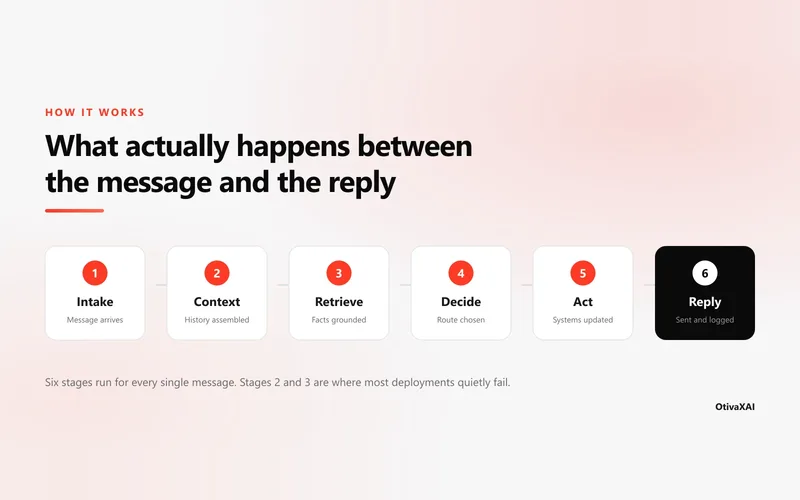
What will not work yet is anything with a write action behind it. Booking into a live calendar, updating a CRM stage, issuing a refund: those need integrations tested against real data, and they slip more often than the demo suggests. Our breakdown of how an AI virtual assistant actually works walks through where a single reply comes from and which of the six steps tends to break.
Weeks two and three: the work changes shape before it changes size
By the middle of the month the assistant has absorbed the repetitive band of your inbox. Opening hours, pricing ranges, service area, do you do X, how soon can you come out. What is left for your team is denser: fewer messages, each one harder.
That reshaping does not land evenly across your people. The clearest evidence comes from human agents working alongside an AI assistant rather than behind one, but the pattern holds. In a study of 5,179 support agents, access to a generative assistant raised issues resolved per hour by 14% on average and by roughly 34% for the newest staff, while the gain for the most experienced was close to zero (Brynjolfsson, Li and Raymond, NBER working paper 31161, published in the Quarterly Journal of Economics, 2025).
Read that as a staffing observation, because in month one that is what it is. Your newest hire gets noticeably faster. Your best person mostly gets handed the cases nobody else can close, and their numbers barely move. Measure the rollout on your strongest performer and you will conclude it did nothing.
The number that moves first is not the one you bought it for
Ask an owner why they want an assistant and the answer is almost always cost or hours. Ask them three months later what actually improved and the answer is different.
Salesforce's State of Service: AI Agents Edition surveyed 3,075 customer service professionals between 9 March and 4 April 2026. After deploying AI agents, the single most improved KPI reported was customer satisfaction, ranking ahead of rep productivity, average handle time, customer retention and first-response time. Adoption across service organisations rose from 39% to 66% in a year (Salesforce, 2026).
That ordering matters more than it looks. Satisfaction sits downstream of speed and availability, and both of those change on day one. Productivity and handle time sit downstream of process change, which takes longer than a month because it needs people to change habits. So the benefit that arrives first is the one that is hardest to put on an invoice, and the benefits that are easy to put on an invoice arrive last.
That is why rollouts get abandoned in week five. The owner is reading the wrong row.
What does not change in thirty days
Four things. Being blunt about them upfront is most of what keeps a project alive.
- Your headcount. Nobody gets redeployed on the strength of one month of transcripts, and nobody should be. Measurable value inside 60 days is not the same as a saving you can bank.
- Your hard cases. Complaints, negotiations, and anything that is an exception to your own policy still land on a person, and should. An assistant that improvises around a policy is worse than no assistant.
- Your knowledge gaps. It will answer confidently right up to the edge of what you gave it. Month one's real work is reading transcripts and finding the questions you never wrote down.
- Your pipeline maths, if enquiries were never the bottleneck. If you already reply within the hour and still don't book enough work, an assistant makes a fast process faster and changes nothing at the end of it.
Slow movement is normal even where budget is not the constraint. In McKinsey's 2026 survey, 40% of respondents at companies above $1 billion in revenue reported scaling AI agents, up from 27% the year before (McKinsey, The State of AI, August 2026). That is the fastest-moving group in the sample, and it still took them a year to move thirteen points.
A worked example, clearly invented
Illustrative numbers, not a client result. A six-person home services firm takes about 120 enquiries a month, roughly 25 of them outside working hours, with a next-morning first reply on that group.
Put an assistant on FAQs and first replies, and three things become countable inside the month:
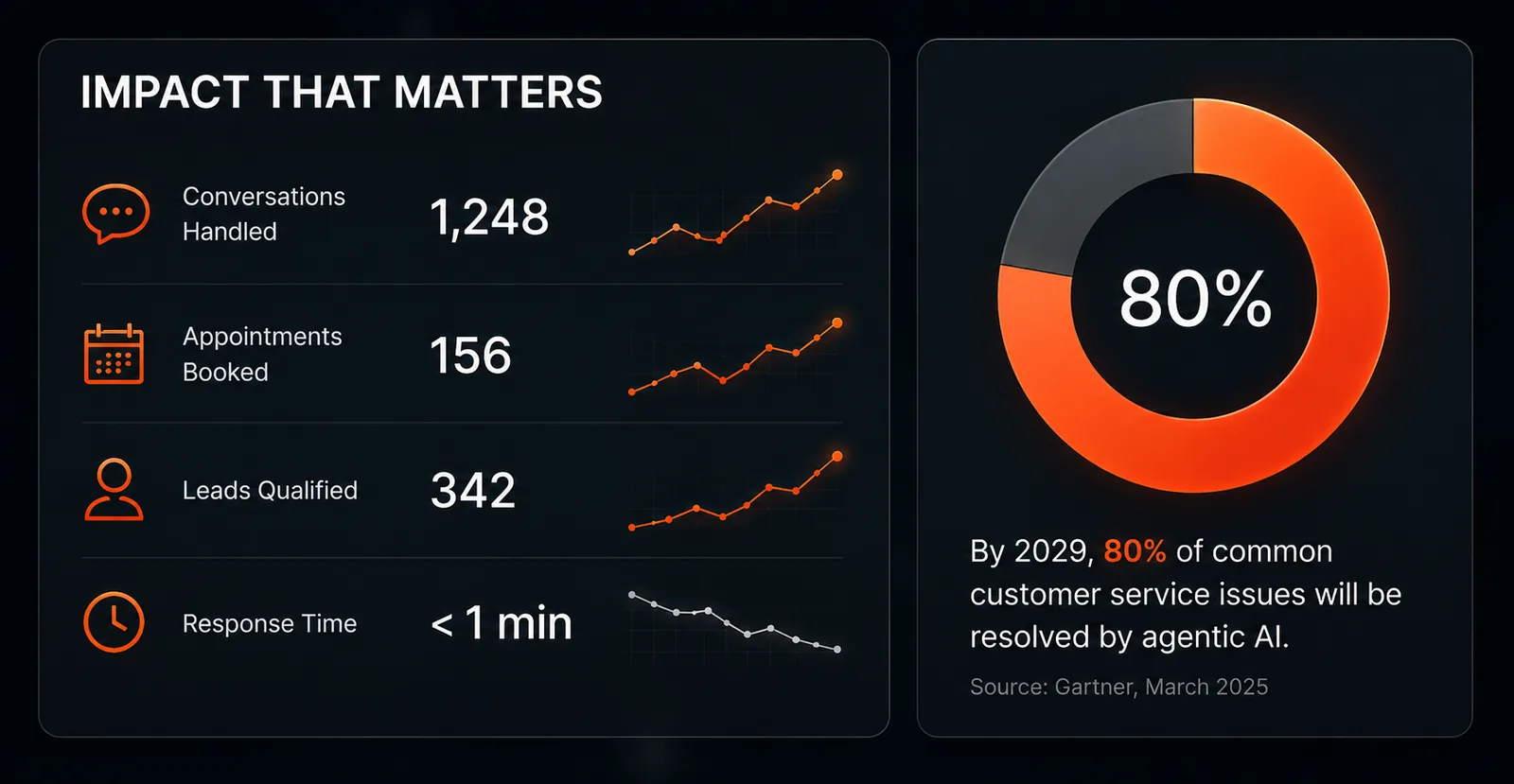
- First reply on the 25 after-hours enquiries falls from around 11 hours to under a minute.
- About 60 enquiries that are pure information, such as whether you cover a postcode or what a callout costs, never reach a person at all.
- The team still handles the same 35 quotes, complaints and scheduling exceptions as before, but with a cleaner queue and a written summary attached to each one.
What does not appear is a smaller wage bill. What does appear, if you were tracking it, is a higher share of enquiries answered before the customer contacts someone else. Whether that becomes revenue depends on your close rate, and that is a month-three question.
Baseline four numbers before you switch it on
You cannot show a change you never measured. Before go-live, write down last month's figures:
- Median first-response time, split into working hours and out of hours. Median, not average, because one holiday weekend will wreck an average.
- Enquiry volume by channel, and the share arriving outside your working day.
- The ten questions your team answers most often, counted. This doubles as the assistant's first knowledge base.
- Your close rate on enquiries, so that when it moves later you can tell whether this is why.
Then, at the end of week one, read fifty transcripts. Not the dashboard, the transcripts. Everything worth fixing in month two is sitting in them, and no chart will show it to you.
Where to go next
Thirty days tells you whether the thing works. It does not tell you whether it pays. Those are different questions on different timelines, and treating them as one is the most common reason a build that was working gets switched off before it earns anything.
If you are still deciding what to buy rather than what to measure, our guide to AI virtual assistants for business covers the category, the four moving parts and what it costs. If you would rather see one job end to end, what an AI booking agent actually does follows a single enquiry from message to confirmed appointment. And if you want this built around your own numbers, that is what our AI agents work is.
Ready to stop missing enquiries?
Book a free 20-minute call and we'll show you what an agent would answer for you.
Book a Free Demo