
30 hours a week back on technical SEO audits
A weekly technical audit on 5 client sites, sorted into what is new, what got fixed, and what is still open before anyone opens it.
Estimated. Nothing here has run in production yet.
The problem
An agency that sells technical SEO has to show its work every week, so it sends an audit. One pass over a large site turns up thousands of issues, and about 95% of that list is identical to the list sent the week before.
By the second send the client has stopped opening it. The one thing a recurring audit exists to prove, that the work is moving, is the one thing the report never shows.
The fix is not a shorter list. It is a different question. Not "what is wrong with this site" but "what changed since last time".
Before
Per client, per week. Start the crawl and wait for it: 30 minutes. Export it and clean it into a sheet: an hour. Pull real visitor speed numbers for a sample of pages, a URL at a time: 45 minutes.
Then the part that carries the whole report. Read this week's sheet against last week's, line by line, to work out which issues are new, which got fixed, and which are still sitting there. 2 hours, and it is entirely manual.
Then write the summary, decide the next steps, and pour the lot into the branded template. 90 minutes.
About 6 hours. For one client. Then do it again for the next one. At 5 clients that is 30 hours a week, or 3 working days, spent producing a document that is 95% last week's document.
And the comparison is the step that goes first when the week is busy. It is the slowest one, and it is the only one nobody can see you skip. Skip it and the audit goes out as a raw list again, which is how a client learns to stop opening it.
Every week. 5 client sites. A list that is 95% the same as last week's.
Before
- Start the crawl and wait for it
- Export it and clean it into a sheet
- Pull speed numbers, a page at a time
- Read it against last week's sheet, line by line
- Write the summary and the next steps
- Repeat for every client on the list
About 6 hours per client, per week
Now
- Read the report
About 5 minutes
Now
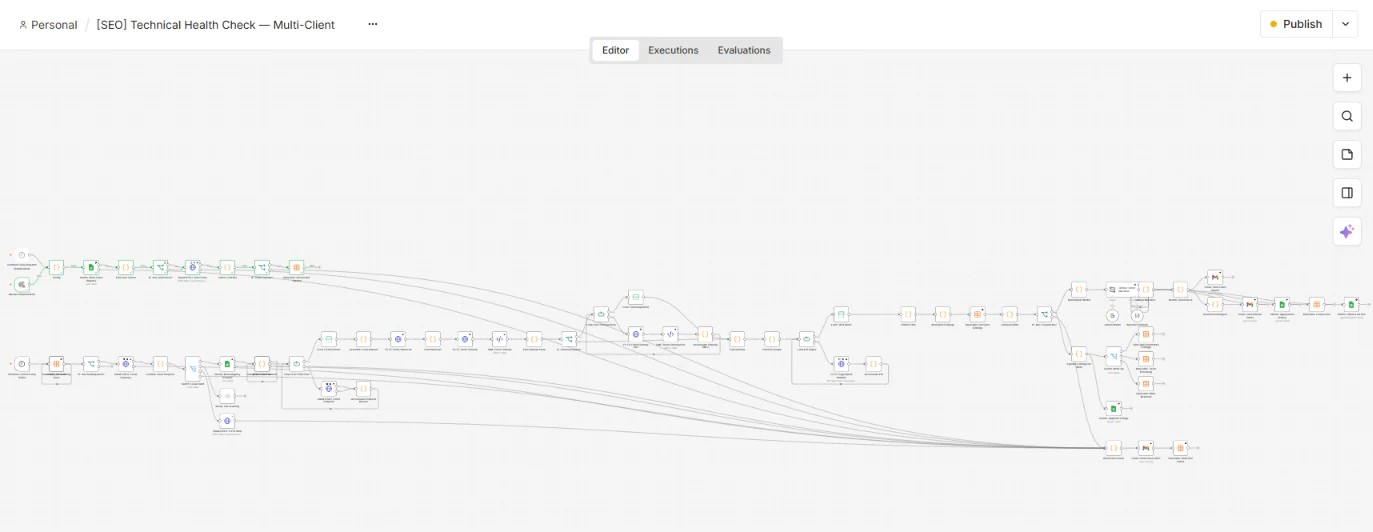
Every site is checked on its own schedule. When a check is due the whole site is crawled, every page, image, link and redirect, with nobody starting it and nobody watching it finish.
Then the part a crawl cannot see. Real visitor speed data is collected for a sample of pages, including the responsiveness numbers a lab test cannot produce.
Roughly 35 checks turn the raw crawl into findings that all look the same: what is wrong, which page, how severe, and why it matters. Every finding carries a stable identity, which is the unglamorous part that makes everything after it possible.
This week's findings are then set against last week's and sorted into new, resolved and still open, before a single word is written.
Only then does the writing happen. A model writes the plain-English summary and the recommended next steps. It never sees the raw data, only the final counts and the score, so every figure in the report is calculated first and described second.
What lands is a branded document carrying a 0 to 100 health score, the 3 lists, and a short set of prioritized next steps. Every finding is also kept over time, so a problem that keeps coming back is visible months later rather than only week to week.
And nothing goes out unchecked. Every result is tested for plausibility before it is compared or sent, so a failed or half-finished scan is never mistaken for a clean site. If a scan looks wrong the client gets nothing and the team is told to look at it first. One client's site being slow never holds up anyone else's report.
What changed
About 6 hours a week per client that would go somewhere else. Across 5 clients that is 30 hours a week, or 3 working days.
Valued at a $10 an hour cost of staff time, 30 hours a week is roughly $15,000 a year, or about 195 working days.
The comparison stops being the step that gets dropped. New, resolved and still open are sorted every week whether the week is busy or not, so what the client opens shows movement instead of a list.
And one quieter change. A broken scan and a clean site would stop looking the same. Today both produce a short list, which is exactly how a check that failed reads as a good week.
Sending the same audit every week?
If the list going out to a client is mostly last week's list, the comparison is the part worth handing over.
Book a Free DemoBuilt with n8n, a site crawler, the PageSpeed Insights API for real visitor speed data, Google Gemini for the written summary, and a database that keeps every finding from week to week.