
10 hours a week back on invoice data entry
Every invoice that lands in the folder is read, filed and written up to billing before anyone opens it.
Estimated. Nothing here has run in production yet.
The problem
A business takes 15 supplier invoices a day. They all arrive in the same folder, and nothing else about them is the same. Different suppliers, different layouts, and different words for the same thing: Total, Amount Due, Balance Due, Grand Total.
Every one of them has to end up as a row in the same sheet, with the same 8 columns filled in. So somebody opens each document and types it out.
The work is not hard. It is that it never stops, and it is never twice the same.
Before
Open the folder and work out what is new. Open the invoice. Read it. Find the supplier name, the invoice number, the date it was issued, the date it falls due, the subtotal, the tax, the total and the currency. 8 fields, sitting somewhere different on every document.
Type them into the sheet. Rename the file so it can be found again. Write a short note to billing saying what came in.
About 8 minutes when the invoice is ordinary. 15 a day is 2 hours, every day, before anything else in the week gets started.
And the mistakes are the quiet part. A digit transposed in a total, or a due date read off the issue date line, does not look like a mistake in a spreadsheet. It looks like a number. It gets found when a supplier calls.
Every day. 15 invoices. 15 layouts. The same 8 columns.
Before
- Open the folder and find what is new
- Open the invoice and read it
- Hunt for 8 fields on an unfamiliar layout
- Type them into the sheet
- Rename the file so it can be found later
- Write the note to billing
- Repeat, 15 times
About 2 hours a day
Now
- Read the summary in the billing inbox
About 10 minutes a day
Now
Nothing is checked on a schedule. The moment an invoice lands in the folder it is picked up.
What lands there is not always an invoice. Statements, delivery notes and the occasional screenshot go in the same place, so the first thing that happens is a filter. Anything that is not an invoice is left exactly where it is.
The rest is read as a document rather than as a wall of text, and that distinction is the one that matters. A layout nobody has seen before is still a page with a total on it, so a new supplier does not need anyone to set anything up first.
Then the same 8 fields come off it every time: supplier, invoice number, issue date, due date, subtotal, tax, total and currency. Not 8 boxes in 8 fixed positions, but 8 answers, wherever they happen to sit on the page.
The row is appended to the sheet. Same sheet, same columns, same order. Nobody had to learn anything new, and nothing downstream of the sheet had to change.
Then billing gets an email. Not the document forwarded on, but a written summary: who it is from, what it is for, what it comes to, and when it falls due.
And nothing is paid, approved, or sent outside the company. The row is written and billing is told. Every decision after that is still a person's.
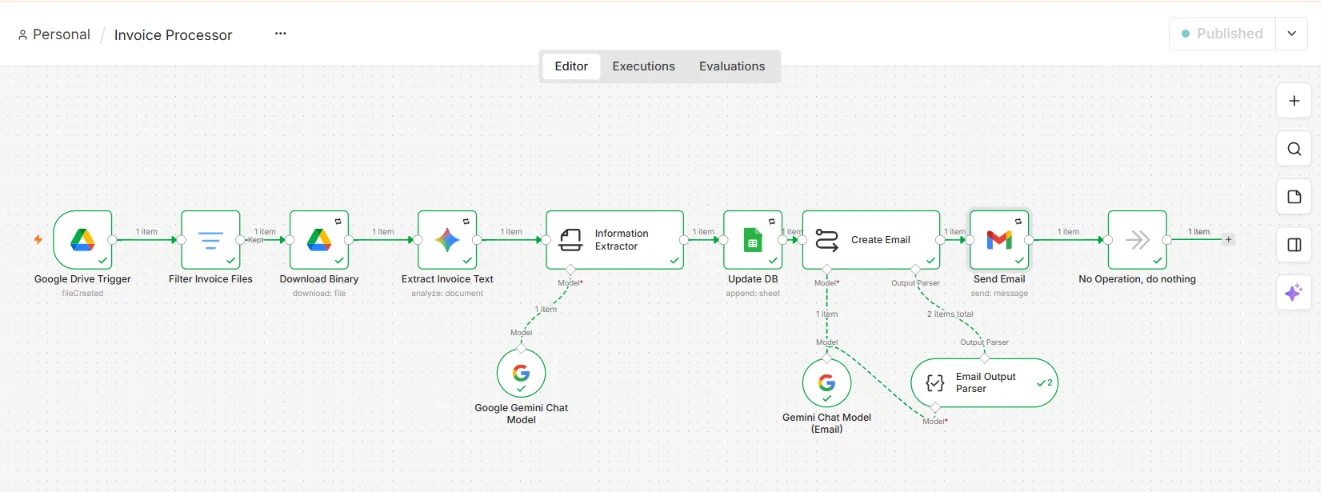
What changed
About 2 hours a day that would go somewhere else. The daily pass over the invoices would be roughly 10 minutes of reading a summary.
Valued at a $10 an hour cost of staff time, 10 hours a week is roughly $5,000 a year, or about 65 working days.
The 8 fields would come off every invoice the same way, whoever is on that morning and however the supplier chose to lay their page out. Two people would stop keying the same document two different ways, because neither of them would be keying it.
And one quieter change. An invoice arriving and an invoice being entered would stop being the same event. Today the only record that something came in is that somebody typed it up, which is why an invoice nobody got to is invisible until it is late.
Typing invoices into a sheet?
If somebody opens every invoice to find the same 8 fields in a different place each time, that 2 hours a day is worth a conversation.
Book a Free DemoBuilt with n8n, Google Drive, Google Gemini for reading the documents and writing the summary, Google Sheets, and the Gmail API.